A New Revision of the New
Drone Films / Essay Films
As a small boy staying up late in the 1960s, I saw, on my family’s black and white tv with the antennae known colloquially as “rabbit ears,” a skit about a man flying economy class on a plane. It was on the Ed Sullivan Show, which was, for me at 8, very grown-up, very sophisticated. The Ed Sullivan Show was a variety show that consisted of a range of skits, from vaudeville to stand-up comedians that were at the time iconic for popular culture, like Jack Benny and Milton Berle. Later on, it would be on the Ed Sullivan Show that I would experience for the first time the Beatles. This particular evening, at the end of the skit about a man flying economy on a plane, the man hears the captain’s voice announce, “Economy passengers, I want to thank you for riding with us today... First class passengers, we will be landing in five minutes.”
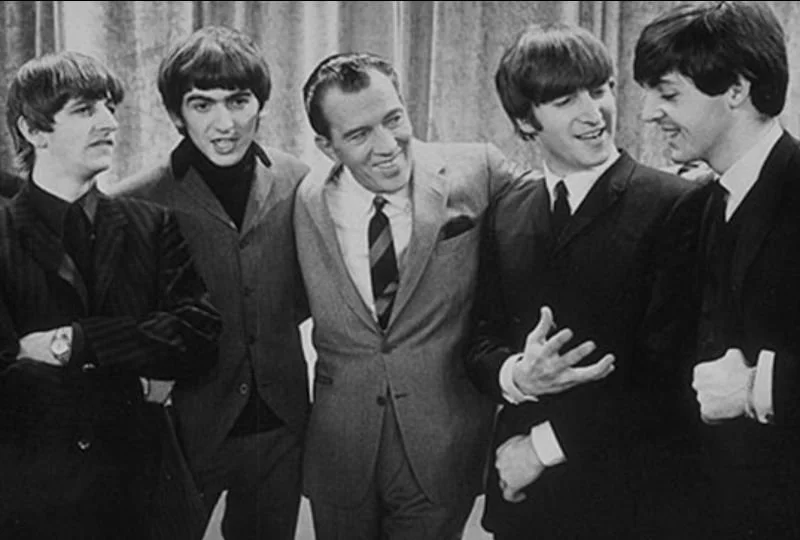
“Later on, it would be on the Ed Sullivan Show that I would experience for the first time the Beatles.”
Of all the skits I ever saw on the Ed Sullivan Show, the last joke of this one is all I remember. I was hardly a “red diaper baby”——my parents had met while my mother was working for the Republican Party and my father had been a short time before honorably discharged from the Marines——and yet the only joke from the Ed Sullivan Show that I remember from this time of innocence is about class.
I returned at the start of this summer from Europe——before it burst into flames from the climate change that billionaires and oil companies spend their money to convince us is a hoax. I had been there for many months, working on various film projects. Upon my return, I learned that because of identity theft my Medicare Plan Part B had been cancelled. I went to the local office of the Social Security Administration. I once had to report a lost U.S. passport in Krakow when Poland was a Soviet-bloc communist country. It was good training for the U.S. under Trump today. It may seem paradoxical to compare the U.S. under Trump with Poland under Soviet-style communism but in both cases when visiting state agencies I have gotten the distinct sense of an empire crumbling. In both systems at both times employees work in systems ransacked by the powerful, in the offices of which photos of the biggest fools represent power.
The U.S. today seems to me like a strange place where artificial intelligence installed by a dysfunctional airline could decide mid-flight that only first class passengers actually get to land. In fact, isn’t that what the U.S. has become, or what its ruling class aspires to it becoming?
In May, I was at Cannes with Super Athens, a film I decided to make in solidarity with Palestine on a shoestring budget after Netanyahu said in the future Israel would be Super Sparta. Super Athens is what I would call a drone film. The art critic Claire Bishop in her book Disordered Attention writes about the trope in Modernism of displacing the terminology of evolving tactics of warfare into the realm of the arts, beginning with the Italian Futurists. My use of drones to describe a kind of contemporary filmmaking is partially inspired by this tradition. It is also the case that the use of drones is arguably as ubiquitous in contemporary filmmaking as in contemporary warfare. This intersection of war and cinema makes me think back to 1986 at the brasserie La Coupole in Paris interviewing Paul Virilio, author of War and Cinema, about the crash of the Space Shuttle Challenger——the actor Jean-Pierre Léaud walking up to our table, looking me in the eyes, approaching from behind Virilio, and then bending towards me over Virilio’s shoulder and saying to me very sincerely, “Il est trés intelligent,” and then disappearing. The most salient point Virilio made speaking to me was that the last communication from the ship sustained a fiction of human control when there wasn’t any.
War and cinema are conjoined again tightly in the drone. Drones are the expression of——to use a neologism of the French psychoanalyst Jacques Lacan——the hainamoration——the relation of hate to love such as we see emblazoned on the knuckles of Robert Mitchum’s character in Night of the Hunter (1955)——contained in today’s ubiquitous scopophilia. We love to look, we are constantly distracted by looking, and we destroy by looking, including by looking but not witnessing what we see. Most of all, I coin what I call drone films because of their ideological maneuverability. Short films on the internet and even feature films with ultra-low budgets are like drones that spool out a hair-thin fiber-optic, impervious to restraints works with larger budgets encounter. In addition to Super Athens being a drone film, it is an essay film. The editing process has been long, frustrating at times, but I am satisfied that now it is able to transmit something significant at last.
The reputation of Cannes as a festival is financed——as is the dominant global film industry——by the construction of films the size of aircraft carriers. Those of us who care to look closer, however, know this is far from the only kinds of films that this renowned festival of France celebrates——including the work of Hong Sang-soo that inspired my film Ikonophile Z——of which you can now purchase a Blu-ray. As I have written before, Cannes still retains links to its time when it stood as the pre-eminent beacon in cinema for anti-fascism, when Naziism was on the rise and the Venice Film Festival was identified with Mussolini and Italian fascism. My friend the historian Tangui Perron in an interview in the periodical Jacobin entitled Class War on The Red Carpet recently wrote about these often-overlooked roots of the Cannes Film Festival.
Two films in the States that have been unexpected hits this summer started as what could be called drone films. Of the two of them, I have been particularly impressed by Backrooms by Kane Parsons. The main press keeps focusing on the young age of the filmmakers of these two films. Youth with no qualifiers is one of the oldest tropes that frequently serves to hide something important in plain sight. The importance of Backrooms goes far beyond this cliché.
The ideological maneuverability of drone films is key because we are living through a time such as Gramsci described being the 1930s in his Prison Notebooks. At that time, imprisoned by Mussolini, he wrote: “The crisis consists precisely in the fact that the old is dying and the new cannot be born; in this interregnum a great variety of morbid symptoms appear.”
Yes, Backrooms, which is set mostly in a furniture store without customers in a deserted shopping mall in the U.S. in the 1990s, is analogously about the arrival of the internet and foreshadowing our current experience of the arrival of AI but it is most importantly about the interregnum that we have entered and the variety of morbid symptoms that define it.
Among the endless detritus that plays a role in Backrooms is a t-shirt found in a laundry room and worn by one character upon which is emblazoned the words “Stop Apartheid.” The shirt reads like a golden oldie but it takes on new meaning——it screams——after the clampdown on free speech on American campuses about Israel’s blatant infliction of genocide on the Palestinians of Gaza——the emperor has no clothes——they are all on the floor of a room to which he finds it impossible to return and so stands utterly naked.
In the 1970s I was one of the students at a small private college occupying the administration building in order to get the trustees to divest from companies doing business in South Africa. Flash forward over forty years to a little over a year ago, I was at a dinner given by the parents of one of the students graduating beside my daughter from another small private college. The bear in the room that evening appeared by the end of the meal: most of our children and many of their classmates were facing various kinds of disciplinary action——loss of employment, banishment from attending classes on one of the campuses of the affiliated colleges, loss of financial aid and deportation——as punishment for participation in peaceful protests that dared to call what Israel is carrying out against Gaza——including with the latest weapons of the world’s remaining super power——a genocide. The U.S. Congress wanted access to all communications about these horrible naive young people who didn’t understand that what was happening was just business as usual. Now the violence is reaching a new all-time high in the West Bank as Israeli Settlers carry out daily pogroms on Palestinians, trying to expand their ethnic cleansing. The suppression of free speech by the power of money wielded by both the U.S. government and private American benefactors has effectively gagged free speech on campuses.
The immediate connection that evening at the dinner to apartheid in South Africa——the one unmistakably referenced on a t-shirt in Backrooms——is that many of the parents——myself included——were of the generation whose education had included refusing to accept apartheid in South Africa as business as usual. I can’t speak for all of the other parents but many of us transmitted to our children what we thought we had learned, that exercising our right to speak out was an important part of our education——of our role in society as young people lucky enough to get an extraordinary education. I remember from among my student activities in particular the pride I sensed in our silence the time we formed two rows between which the trustees walked as they exited a meeting. For a week we occupied the administration building while allowing it to continue to conduct business. America’s universities and colleges sometimes were punitive but nevertheless generally tolerated our acts of free speech——often carried out with the support of faculty. But now, in the wake of the targeted killing of journalists and medical workers——and small children by snipers——including with the use of guns mounted on quad copter drones (see this June 2026 UN report) what we have experienced is a clampdown and an aggressive silencing of the free speech of the young people we have raised far surpassing what we could have imagined. As we shared the desserts downtown in Manhattan at the home of our hosts, the lessons we had transmitted to our own children turned out to have been naive and this has left me feeling bitter and outraged but not alone.
The t-shirt in Backrooms points to the surrealism of historical forgetting we are asked to accept today. A film like Backrooms——which, on the face of it, isn’t a political film——can still stylistically show a maneuverability that raises it heads and shoulders above the most recent work of a filmmaker who has many times in the past made films that remain memorable to me. I am speaking about Disclosure Day by Stephen Spielberg. At the end of that overhyped disaster, when they show the whole world glued to screens watching the same images exclusively on major networks, I thought this is really the last gasp of a dying ideology. I find myself trying to remember the words to Gil Scott-Heron’s “The Revolution Will Not Be Televised.”
There is a small gallery in Athens called the Red Carpet Project Space. It’s run by Kimona Venieri. The art it exhibits by various artists shares an irreverence to unspoken cultural standards that for the most part I find much more relevant than the red carpet of major festivals today that exclude talking about Gaza and the ongoing genocide. The use of a red carpet at festivals goes back to the Oscars in 1961 and from the start was given a patina of antique value by association with the red carpet that Clytemnestra lays out for her husband Agamemnon in the Greek tragedy named after Agamemnon by Aeschylus. It expressly therefore references spilled blood. The small Athenian gallery’s evocation of this red carpet is for me much more engaging and timely than its reflexive use has become by major festivals.
The Agamemnon is the first play of the only extant trilogy we have of Greek tragedy, The Oresteia. This trilogy is all about the tenuous establishment of justice in the patriarchy of Athens. Agamemnon returns with Cassandra. She is a Trojan priestess to Apollo that Agamemnon has taken as a prize following the pillaging of Troy. The departure of the Greek armada against Troy had been initially delayed until Agamemnon carries out the sacrifice of Iphigenia, his daughter whose mother is Clytemnestra. Aeschylus in his use of the Greek language emphasizes a link between the complexity of the stitching of the net in which Clytemnestra traps her husband after he steps off the red carpet and her own complexity of thinking. Aeschylus implies figuratively a connection between the thinking of women and the structure of a net. Our own word “complex” has folded into it this same association through its etymological link to a fold——still present in the French word from the same Latin root, un pli, a fold. This complexity is not biological but manifested in the context of a dominant order to which it represents a resistance, as Mari Ruti wrote about in her book Penis Envy and Other Bad Feelings (2018).
The works exhibited in the Red Carpet Project Space in Athens generate a complex reflection on the Scotch tape——the kind that doesn’t become invisible——holding together the current world order. We live in a time that requires complexity of thinking even as complexity is suppressed.
While the collecting of data requires that our differences be reduced to categories of the same, for which the Latin root is idem. Our English word “identity” is derived from this Latin root. It occurs to me——as I try to deal with the fallout of identity theft—that the concept of identity itself can be used——and frequently is——to steal from us the complexity and contingencies of our relationships of solidarity.
I once was in Beirut for the wedding of the son of an old Iranian friend. The bride was Palestinian. I was having a marvelous time in Beirut. I figured I would be lost during the actual wedding. It turned out the bride was Greek Orthodox——a community with which I have been intimately involved throughout my life, even though I am not myself Greek Orthodox. I had the feeling that day that no other member of the groom’s family felt as home as I did with the particularities of the ceremony. Last week I returned to thinking about Beirut when I saw Do You Love Me? (2026) by Lana Daher, at Metrograph Cinema on Ludlow Street. Do You Love Me is a marvelous complex but lucid film that is the culmination of years of archival work by Daher. It is constructed from clips from the work of many other filmmakers from Beirut and beautifully joined with a soundtrack of music from Beirut that reflects the filmmaker’s experience working as a DJ. The films by other filmmakers from which she drew her clips and then with her editor and co-writer Qutaiba Barhamji wove them together is carefully organized and cataloged on a website devoted to the film Do You Love Me. The design of the homepage reminds me of Early American patchwork quilts with which it shares more than a superficial similarity. This crafted conjunction of a film to a website is evocative of the complexity being generated between the arts and their unfolding relation to their evolving audiences. This transgressing of boundaries, this celebration of the complexity of the patchwork which is Beirut and which is the city in which I write this, New York City, and the current innovation of the arts in their relation to their audiences remain not only a hopeful sign but a force for change, so that a new revision of the new of which Gramsci spoke can be born.