
Psychology
A personal memory
As someone who has spent years navigating the ecology of interpretation in which the works of Lacan re-engage with his readers, I am wary of what is usually referred to as “psychology.” I feel a tinge of pain every time a young person in response to hearing I have made fiction films with screenplays based on the fictional works of Lacanian psychoanalysts tells me they are taking a course in psychology, thinking this will put them in contact with psychoanalysis. In most cases, nothing could be further from the case. Lacan himself was dismissive of what he saw as the underlying ideology of psychology. He was referring to it as the institutions that have appropriated psychology as a title, frequently reducing the breadth of what one imagines could be covered by such a discipline to its role in the governing ideology of capitalism. In the United States psychologists only became licensed to see patients following WW2. Psychoanalysis in the United States during this same period suffered a similar fate—largely losing the revolutionary qualities that continued to exist in the writings of Freud and among some of those who became psychoanalysts and their patients afterwards. For the most part, after the Holocaust and the Second World War had directly affected so many clinicians who fled from Europe, adaptation became the dominant paradigm in a United States obsessed with the threat of communism. However, exceptions existed then and have continued to exist. A personal memory makes it impossible for me to forget this.
In the second grade I was sent to see a psychologist at the public school I was attending. The private school my younger brother and two younger sisters attended had not accepted me. I don’t know the reason I was not accepted but as a young child, I was told later, I had a pronounced speech impediment. I could not pronounce the letters “R” or “L.” My name was “Wichard Weeds.”
Once a week a person whom I later learned was a psychologist would take me in the morning into a small room adjoining the empty cafeteria and play board games with me. I have no memory of him having ever said I had any kind of problem or that there was anything about me that needed fixing. What I do remember is years later my mother told me that he had told her that if he ever had a son he would want him to be like me. I have never forgotten this.
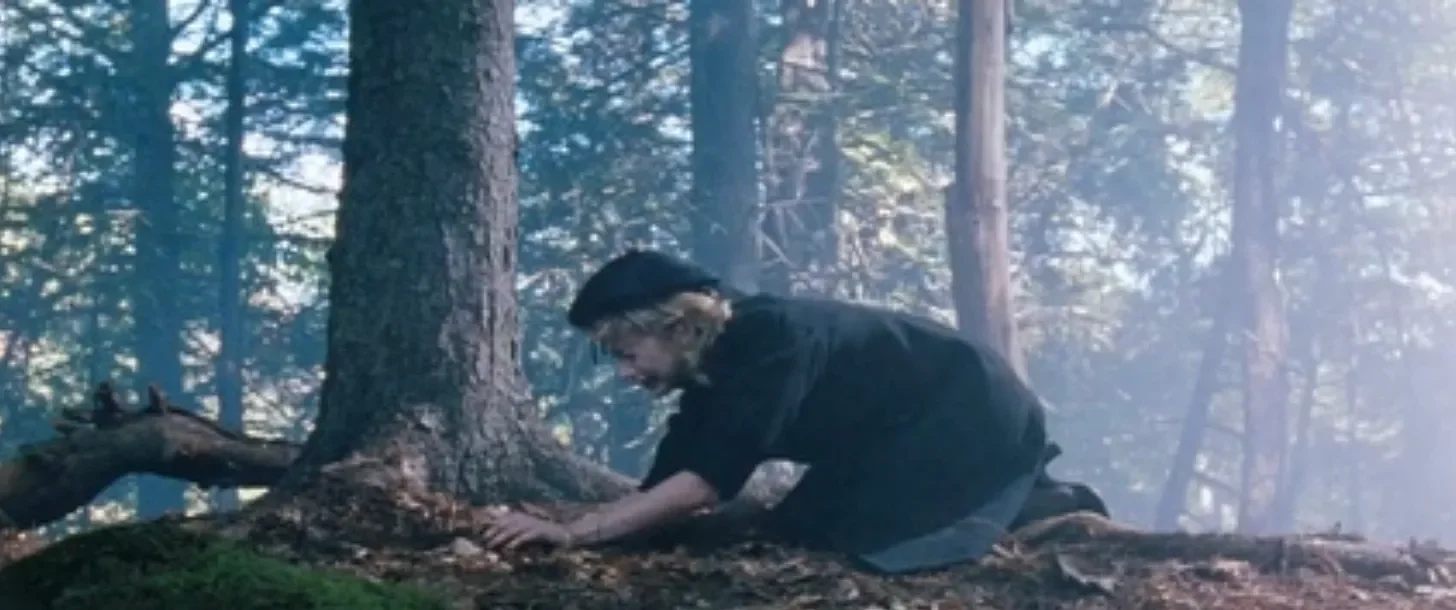
Anna (Michelle Williams) mourning the death of her brother in A Hole In One
As I have recounted elsewhere, my mother’s brother, her only sibling, who had been named Richard after her father, had spent ten years in a Veterans Psychiatric Hospital. Diagnosed with schizophrenia, he had been twice selected for a transorbital lobotomy but the chief psychiatrist on both occasions had ruled against the recommendation. Around the time I was sent to see the psychologist, my uncle died, when—either intentionally or accidentally—he was hit by a train a short distance from the hospital. Now, thinking back, I recall how deeply concerned my mother always was that I might be like her brother. I remember her telling me that I needed to not stand out or I risked being taken away. My being sent to see a psychologist must have intensified her fears. I like to think the psychologist picked up on how deeply concerned she was with what his diagnosis—his judgement—might mean for me. His telling her that if he ever had a son that he hoped he would be like me he must have known would alleviate to some small degree her fears, and for this reason, I imagine, she remembered what he said and later told it to me. He had not offered a diagnosis about me to my mother but had instead spoken about his own desire.
Visit the Richard C. Ledes Substack and consider becoming a free or paid subscriber.